

On this page
On the Sell Better show on Oct 20, 2026, Jed Mahrle and I took a random YC company, Ascenix, from zero to a segmented campaign by hand. No slides. This is the written version, with every prompt and query so you can run it yourself.
The filters everyone starts with are industry, headcount and title. A list built only on those gives the copy nothing specific to say. The rest of this article is how I get past them.
Who is Ascenix, the example company?
Ascenix (ascenix.co, YC F26, Toronto) calls itself "the incident intelligence layer for long-term care." In plain words, it reads the incident notes nurses already write in PointClickCare, MatrixCare or Yardi. It turns those notes into incident reports, flags compliance gaps, supports reimbursement and ranks residents by risk in a "Risk Radar."
Its one public case study covers a customer that runs 12 Ontario homes. It reports 80% less time on manual fall analysis and a 15% drop in non-compliance incidents inside three months. It also reports zero missed fall follow-up findings at one home's inspection (case study).
What does a five-minute segmentation check look like?
I ran the checks on one real target from one of our outbound pipelines, a large Ontario long-term care operator. I ran every check on Oct 20, 2026 with free public tools.
| Check | What came back | Tag |
|---|---|---|
| DNS TXT | facebook-domain-verification=... and an SPF include for an outbound mail relay | Meta Business verified, so check the Ad Library |
| DNS MX | GoDaddy (secureserver.net) mail servers | Email routing note |
| Blog path check | /blog/ renders a real page (not the soft-404 fingerprint) | blog exists |
| Recency | WordPress sitemap index: post-sitemap lastmod 2026-10-20 | blog=active |
| Careers path check | /careers/ renders | careers present (check which roles) |
| Locations | 46+ LTC homes listed on the site; 54 homes after a recent acquisition per the company's own LinkedIn post | locations=10+, buyer=parent |
The DNS and sitemap checks took seconds. They told me this operator is putting money into its brand. The Ad Library is the next stop to confirm the ads.
It runs 10+ homes, so my email goes to head office. That means the VP Clinical Services or VP Quality, with the home's Director of Care as the champion.
Which of these checks have I actually tested?
I only label something TESTED if I have run it, and I say where. Anything I wrote for this show and haven't run yet is marked UNTESTED. Run those in Google before you build a list from them.
| Piece | Status | Where it was tested |
|---|---|---|
| DNS checks (MX, TXT tokens) | TESTED | MX classification on 14,001 trades firms and TXT probing on a 400-domain sample in one of our outbound pipelines; live on one pipeline account Oct 20 |
| DNS CNAME check for blog/resources subdomains | UNTESTED | Written for this article |
| Blog / resources page check (path waterfall with soft-404 fingerprint) | TESTED | My page-signals checker; live on one pipeline account Oct 20 |
| Google queries for blog, resources, newsletter, careers, reviews | TESTED | Research process builder champion patterns, avg quality 4.0 of 5, 3,357 searches on 25 companies |
| Recency via sitemap lastmod | Live-checked on one domain | One pipeline account Oct 20; not yet run as a system |
Recency via RSS and after: | UNTESTED | |
| Meta Ad Library scraper and Google Ads Transparency checker | TESTED, awaiting human review | Ads enrichment v3 scored 1.00 on dev and holdout (v2 scored 0.50); Meta came back unknown on 5 of 10 companies with no verified social handle |
Owner search: site:linkedin.com/in "{company}" (CEO OR founder OR owner ...) | TESTED | Google results API gap-fill: 3,283 people on 756 of 1,293 domains, 0 failures |
| Owner search: BBB, then direct search | TESTED | 93% accuracy across 15 local businesses |
| Google Maps scraper (RapidAPI Maps Data) for list building | TESTED | 5,446 accounting rows and 10,568 AEC rows in one of our outbound pipelines (Sep 22-23, 2026); not yet run on long-term care |
| Nonprofit vs for-profit detection | UNTESTED | Test on 20 known homes first |
| LinkedIn profile-body keyword search | UNTESTED | No tested asset yet |
| LTC title, location, parent-company and database queries | UNTESTED | Written for this show |
What research prompt do I start with?
This is the exact prompt I ran live. It's the baseline, not the finished research. You copy it, swap in the website and go deeper from what comes back.
Budget: 400 targeted searches. I need you to gain an understanding of the ICP of {WEBSITE PROVIDED}. Start by digesting their home page contents, researching the founder and finding PR about the company. Distill that company information into a well defined value proposition, if information is limited on the product, do further domain level research to fill in the blanks. Try to find competitors of the brand by researching 'alternatives to X' on google. Based on the number of competitors in the market and their maturity, create an assessment of the current market age -> is the product emerging, or is there some awareness, vs does the whole market already have a solution? Include a column on how we can position against it. Explore relevant subreddits, competitors trust pilots or complaints about the old solution in order to get a feel for the exact language they use to describe their problems. Rank their problems from big business concerns to personal issues, focus on product level problems not support or bad service. Create an old vs new matrix based on this. Outputs: Company Summary in plain language; target industries and personas + the website of 2 companies they'd want to sell to and why; the before and after matrix to understand market maturity; real problems their target market talks about in their own words with links to sources; competitors including battlecards; relevant subreddits, threads, and links to review sites (sources are very important); what publicly available databases can give us proprietary data on their market or act as a signal for outreach (RFPs, gov contracts etc). Full research report should be 3-5 pages in a google doc.For this show I added one more step. Find the job titles that belong to this market and check which of them control the thing the product touches. For long-term care that list includes Executive Director of an assisted living facility, Director of Nursing, Director of Care, Nursing Home Administrator and MDS Coordinator.
What should I paste under the prompt in ChatGPT?
I run it in ChatGPT with deep research turned on. I paste the prompt above, then paste these lines right under it so the research covers what matters most for segmentation and copy:
Also do the following, and cite a source for each:

1. Insider language: pull exact phrases from Reddit threads where the target buyers talk to each other. Quote them word for word with links. I want the words they use with peers, not the words vendors use.

2. Parent company vs subsidiary: work out whether the company (and each example target) is a parent, a subsidiary, or run by a management company, and who owns whom.

3. Unique offers: list every offer the company makes that is unusual for its market (guarantees, free trials, pricing models, "free if it doesn't work" style offers, integrations).

4. What they position against: this is the most important part. Identify exactly what the company positions itself against: a named competitor, a legacy tool, a manual process, or doing nothing. Quote the lines on their site that show it.

5. Old way vs new way: always define the old way of doing this job and the new or current way, side by side.

6. Market maturity from competitors: count the competitors and note how old each one is. Few or young competitors means an emergent market: buyers do not know the category yet, so the copy has to explain the problem and the new way. Many or old competitors means buyers already know the category and are probably getting outreach about it already, so the copy has to say why this is different from what they already have or have been pitched.
The positioning question is the one I care about most. If you know what a company positions against, you know the old way, the objection and the angle.
Market maturity changes the copy. In a young market I explain the problem and the new way. In a crowded one I say why this is different from what they already have or have been pitched.
What do I add in the second research pass?
Once the baseline report is back, I run a second pass. It asks for four things the first prompt skips.
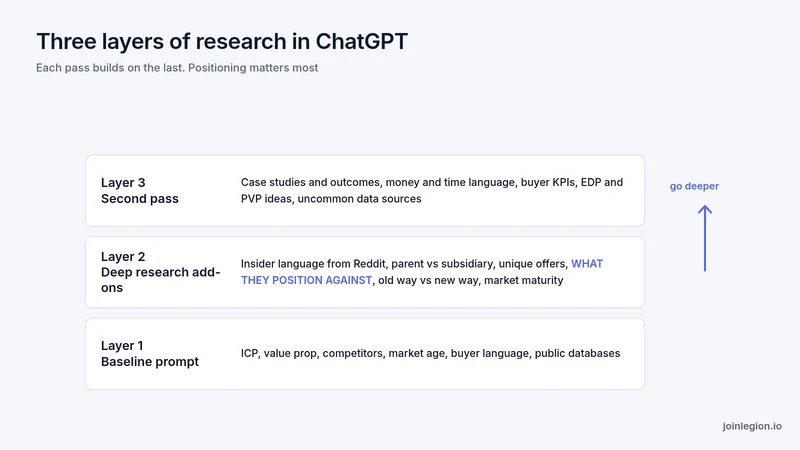
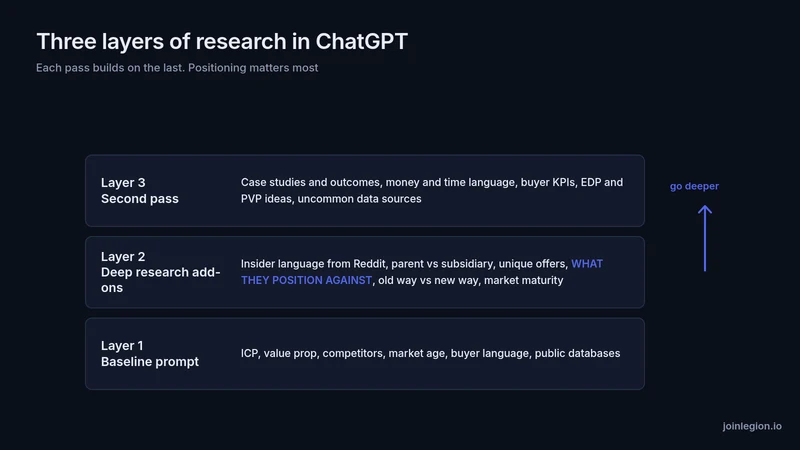
- Case studies and outcomes. What did existing customers measure? For Ascenix that was time on fall analysis, non-compliance incidents and inspection findings. Use the customer's numbers only.
- Buyer language, sorted by money and time. Make money covers funding and reimbursement that reflects the chart. Lose money covers fines, citations, lawsuits and agency staff. Time covers hours spent rebuilding spreadsheets, reading notes and prepping for survey.
- The KPIs the buyer answers for. In US skilled nursing that includes the CMS Five-Star rating, survey deficiencies, the falls-with-major-injury quality measure and staffing hours. In Ontario it includes Ministry inspection findings and compliance orders.
- EDP and PVP ideas, plus uncommon data sources. An EDP (evidence-driven pain) message points at a pain you can prove from public data. A PVP (permissionless value proposition) message hands them something useful before they ever reply. Then list the directories and government datasets that normal data vendors don't carry.
Here is the follow-up prompt:
Using the baseline report above, go deeper. Add: (1) every public case study and its measured outcomes, with links; (2) buyer language grouped into make-money, lose-money and time problems, quoted from real sources with links; (3) the KPIs each persona is held to and who holds them to it; (4) five EDP and five PVP message ideas, each tied to a public data source I can check; (5) uncommon public databases, registries and directories for this market, with the specific fields each one has that a normal data vendor does not. Label anything you could not verify.How do I break a market into segments?
For Ascenix, "long-term care" splits into four market types.
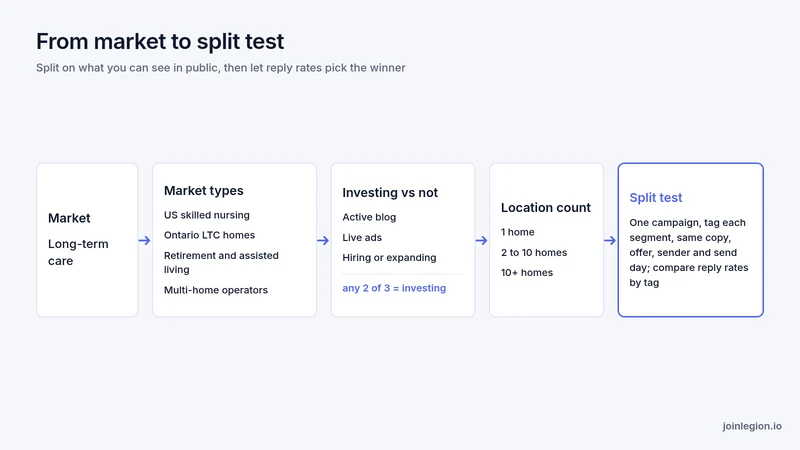
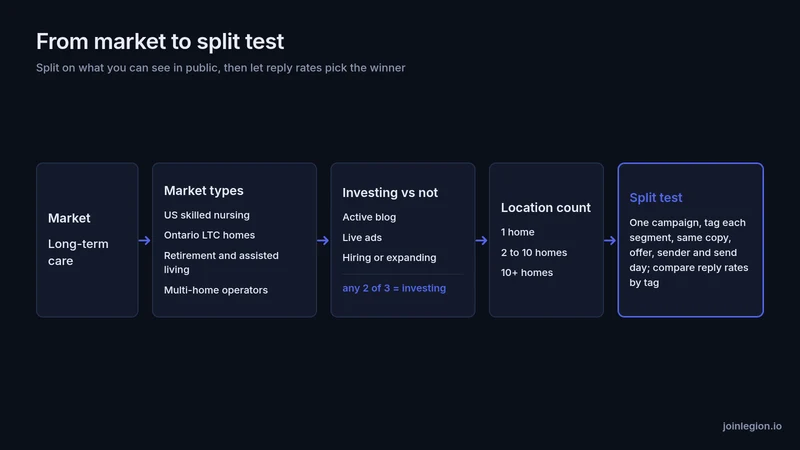
| Market type | Who pays attention to incidents | Why it matters for the pitch |
|---|---|---|
| US skilled nursing facilities (SNFs) | Administrator, Director of Nursing, MDS coordinator, regional VP of clinical | Federal survey (F-tags), Five-Star rating, PDPM reimbursement |
| Ontario / Canadian long-term care homes | Administrator, Director of Care, IPAC lead, falls program lead | Ministry inspections and public reports, CMI funding |
| Retirement homes / assisted living | Executive Director, Wellness or Care Manager | Lighter regulation, family complaints, liability |
| Multi-home operators (chains, non-profits, municipal homes) | VP Clinical Services, VP Quality, COO | "Every home side by side" dashboard, which is Ascenix's leadership view |
Then I split each type again by service (LTC only, LTC plus retirement, or continuum campuses) and by EHR (PointClickCare, MatrixCare, Yardi or other). Public quality signals like star rating, inspection findings and online reviews go on top.
How do I build the local company list?
Care homes are local businesses, so I start the company list from Google Maps. We use a Google Maps scraper through RapidAPI (the Maps Data API). It pulls name, domain, phone, address, category and review counts by search term and location, for example "nursing home" or "long-term care home" city by city.
I queue the geography as an overnight job. Then I qualify a sample before paying for any enrichment, and find the people separately. Maps gives you companies, not people.
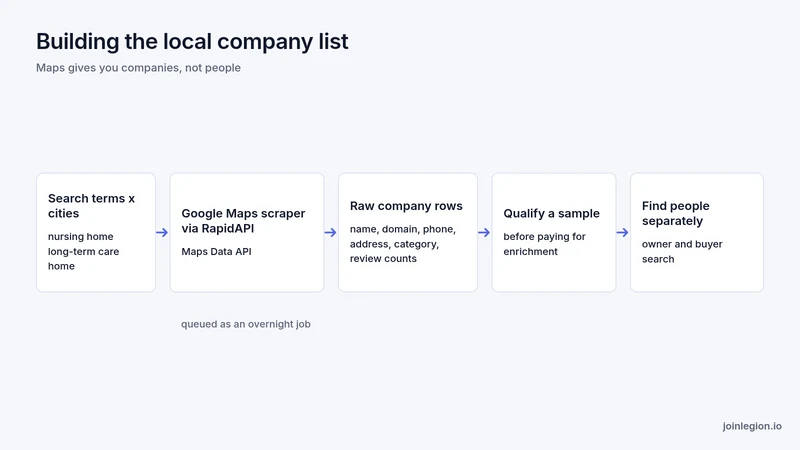
Status: TESTED for list building in one of our outbound pipelines (Sep 22-23, 2026 runs: 5,446 accounting rows and 10,568 AEC rows through RapidAPI Maps Data). It hasn't been run on long-term care yet.
Why is "investing vs not investing" my main split test?
I split every market I work on into companies spending money to grow and companies that aren't. It shows me fast whether growth changes buying, or whether the pain is strong enough that they buy either way.
A company spending money to grow has skin in the game. It wants to protect that spend. A message about risk to the thing it's building lands differently there than at a company standing still.
That makes it a clean first variable. I keep the copy, offer and send day the same, and only the segment changes.
I check three things to tell who is investing:
- Do they have a blog, and is it active? A post in the last 90 days means someone is paid to grow the brand.
- Are they running ads? Live ads in the Meta Ad Library or Google Ads Transparency Center mean real money is going out the door. In care homes that's often for admissions, tours or hiring.
- Are they hiring or expanding? I look for leadership job posts, acquisitions, redevelopments and new beds.
Both ad libraries are free to search by hand, and the tools list at the end has the links.
How do I tag growth and pain signals?
I only tag what I can see.
| Tag | Evidence that counts | Where to check |
|---|---|---|
blog=active / stale / none | Post in the last 90 days / older posts only / no blog | site: queries with after:, the sitemap's newest lastmod |
ads=yes / pixel_only / no | Live ads / Meta or Google Ads tag on the site but no live ads / neither | Meta Ad Library, Google Ads Transparency Center, page source |
growth=yes | Open leadership roles in the last 90 days (Director of Care, DON, Administrator, VP Clinical); new homes, acquisitions or redevelopment; new organization NPIs; new beds licensed | Careers page, job boards, press, NPPES enumeration date, licensing rosters, change of ownership files |
growth=no | None of the above for 12+ months; same home count for 2+ years | Same sources, plus the Wayback Machine on /locations or /homes |
pain=high (overlay) | Recent inspection findings tied to falls, documentation or wounds; low or falling star rating; reviews mentioning falls | CMS health deficiencies file, Care Compare, Ontario public inspection reports, Google reviews |
The score is simple. Any two of blog active, ads yes and growth yes means investing. Everyone else goes in not investing.
How do I use public CMS data to build U.S. outbound segments?
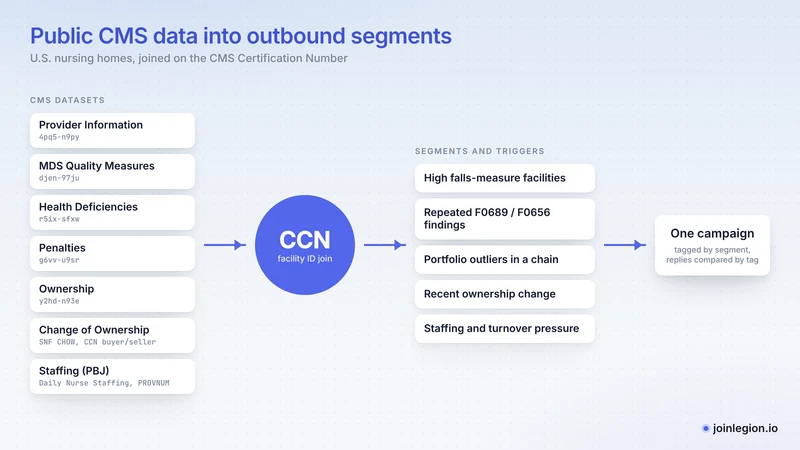
For the pain=high overlay on U.S. nursing homes, CMS publishes facility data on falls, inspection findings, ownership and staffing. I join those records on CCN, the CMS Certification Number for a facility, and turn the results into tags for an Ascenix campaign.
The CMS datasets I use are Provider Information (4pq5-n9py), MDS Quality Measures (djen-97ju), Health Deficiencies (r5ix-sfxw), Penalties (g6vv-u9sr) and Ownership (y2hd-n93e). Provider Information includes fields such as chain name, chain ID, number of facilities in a chain, recent ownership change, staffing rating and nurse turnover. The CMS catalog also lists Skilled Nursing Facility Change of Ownership (Owner Information), Skilled Nursing Facility All Owners and Payroll Based Journal Daily Nurse Staffing.
How do I join the records?
I use CCN as the facility key. A quality measure, deficiency or ownership record can then connect to the matching provider record. That gives me one facility profile with signals from more than one CMS dataset.
I query MDS Quality Measures for one CCN like this:
GET https://data.cms.gov/provider-data/api/1/datastore/query/djen-97ju/0?conditions[0][property]=cms_certification_number_ccn&conditions[0][operator]==&conditions[0][value]=015010The API allows up to 1,500 rows per request. A request for 1,600 returned an error; a request for 1,500 returned 1,500 rows. For a larger pull, I page through results instead of asking for everything in one request.
The measure needs a plain explanation before I use it in a message. CMS measure 410 is the percentage of long-stay residents who experienced one or more falls with major injury. It is a percentage of residents, not a count of falls.
For 2025Q2-2026Q1, one Alabama facility had a 2.99% average across four quarters. Another had 4.41%. Both numbers are shares of residents from public measure data.
Health Deficiencies records are inspection findings, not incident counts. For example, one facility in the data has a March 2, 2023 survey record with F0689 and F0656, each marked severity J, "Past Non-Compliance." I use those codes as data examples. F0689 covers keeping the home free of accident hazards with enough supervision to prevent accidents. F0656 covers building and following a complete care plan for each resident.
Which segments can I build from the joined data?
I'd start with five tags. Each trigger uses fields or records verified in the CMS data research, and each angle gives the campaign a reason to contact that group.
| Segment | Trigger | One-line angle |
|---|---|---|
| High falls-measure facilities | A high value on the major-injury falls measure | "I saw your public falls measure and wondered how your team reviews incident notes across the home." |
| Repeated compliance findings | Repeated F0689 or F0656 findings in Health Deficiencies | "I saw these inspection findings and wanted to ask how your team tracks follow-up across resident incidents." |
| Corporate portfolio outliers | Chain name and chain ID show the portfolio; compare facility measures within that chain | "I can share which homes in the portfolio stand out on this public measure, so your team can decide where to look first." |
| Acquisitive operators | Provider Information shows a change of ownership in the last 12 months | "When a home changes hands, how do you bring incident review into the new operating process?" |
| High operational pressure | Staffing rating or nurse turnover fields show a pressure signal | "When staffing changes, how does your team keep incident review consistent across shifts?" |
In the email I name only the specific measure or finding shown in the record. For portfolio comparisons, I'd compare homes with the same chain fields and use each home's CCN to match its measure data.
How should I score the segments?
I start with weights of 30% for high falls-measure facilities, 25% for repeated compliance findings, 20% for portfolio outliers, 15% for ownership changes and 10% for staffing pressure. These weights are illustrative, a starting point to adjust and not a validated score. After sending, I'd compare replies by tag and change the weights based on what buyers respond to.
How does it route into one campaign?
I'd keep one campaign and attach the segment tags to each facility and contact. The CCN ties the public records together; the tags tell me which angle to use. Then I compare replies by tag without building a separate campaign for each signal.
How does location count change who I email?
Location count changes who holds the budget, so it's my second split.
| Locations | Who holds buying control (Ascenix) | Who you email |
|---|---|---|
| 1 home (independent, non-profit, municipal or county) | The home: Administrator with the Director of Care / DON | Administrator plus DON |
| 2 to 10 homes (regional operator) | Owner, CEO or one clinical leader at head office | VP or Director of Clinical, with the home's DOC as champion |
| 10+ homes or a management company | The parent or management company | VP Clinical Services, VP Quality or Risk, COO; local DOCs are champions, not buyers |
Here's my evidence for Ascenix. Its one public case study was led by the customer's VP of Clinical Services and runs "in every home." Its leadership dashboard compares every home side by side. Both point to the parent as the buyer once there are several homes.
That's my hypothesis, and the split test is how I check it. In the US, the CMS Provider Information file's chain fields and the SNF All Owners file show which management company sits behind a facility. In Ontario, the Ministry's public inspection reports name the licensee.
Should I split nonprofit and for-profit accounts?
Yes. In long-term care it's a big split. Nonprofit, municipal, county and faith-based homes buy differently from for-profit chains.
On the nonprofit side you deal with boards, budgets tied to funding cycles and procurement rules. On the for-profit side it's owners, margins and portfolio growth. Ascenix's own case study page says it runs in homes "including non-profits," so both groups are in play.
How I detect it (UNTESTED as a system, so test it on 20 known homes first):
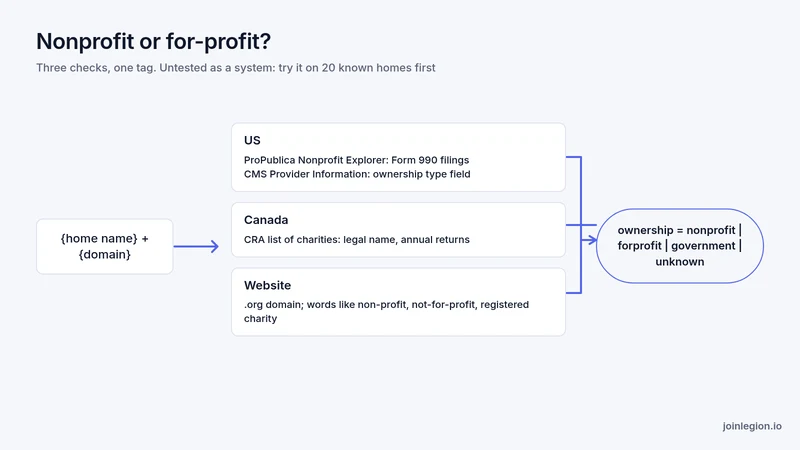
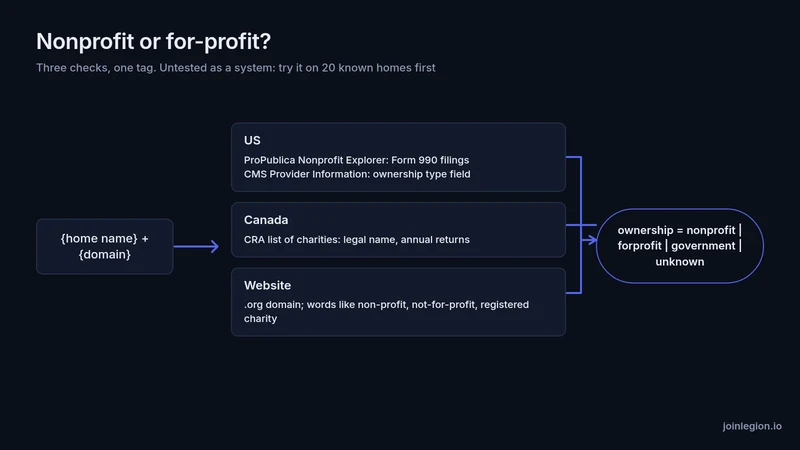
- US: search the name in ProPublica Nonprofit Explorer (projects.propublica.org/nonprofits), which shows IRS Form 990 filings: revenue, expenses, top officer pay and the officers' names. The CMS Provider Information file also has an ownership type field (for-profit, non-profit, government)
- Canada: search the Canada Revenue Agency list of charities for the legal name. Registered charities file annual returns with revenue and directors
- Website: a .org domain plus the words "non-profit," "not-for-profit," "charitable" or "registered charity" on the site
site:{domain} ("non-profit" OR "not-for-profit" OR "nonprofit" OR "registered charity" OR "charitable organization")
site:projects.propublica.org/nonprofits "{home_name}"
"{home_name}" ("Form 990" OR "990")
"{home_name}" ("charitable registration number" OR "registered charity")
site:{domain} ("municipal" OR "county home" OR "operated by the County" OR "operated by the City")
Tag: ownership=nonprofit|forprofit|government|unknown.
What do I say to each segment?
- Investing plus high pain: they're spending to grow and something threatens it. I lead with the inspection risk to the homes they're adding.
- Investing plus low pain: I pitch time saved and one standard across homes as they grow.
- Not investing plus high pain: I pitch survey readiness and avoiding the next finding.
- Not investing plus low pain: lowest priority. I use it as the control group.
How do I turn segments into a split test?
- Pick one variable, the segment. Keep copy, offer, sender and send day identical.
- Write a one-sentence hypothesis. For example: "Investing operators reply at a higher rate than non-investing operators to the same inspection-risk email."
- Decide what counts as success, failure and inconclusive before you send.
- Tag recipients inside one campaign instead of building a campaign per segment. Forty campaigns means forty places to update copy. One campaign with tags means one change, and you can still cut reply rates by tag later.
- Once the segment result is clear, change the next variable (angle, CTA or subject) inside the winning segment.
The goal is to find out which segment replies. I don't assume it going in.
How do I find the right lead when job titles vary?
Titles vary a lot. "Director of Care," "DOC" and "Director, Resident Care" can all be the same job. What people write in their About and Experience sections tells me what they actually run.
Google indexes that text. So a quoted phrase can find the person who "oversees the falls prevention program across 6 homes" even when their title says nothing about falls. Inside LinkedIn or Sales Navigator, the keyword box also searches the full profile. This one is UNTESTED as a system, and the examples are in the query bank in Part 3 of the skill.
My right-lead process works in this order:
- Find the titles that belong to this market.
- Use profile-body keywords to find which of those people control the function you sell into.
- Check location count to decide whether to go up to the parent.
Where is the full waterfall and query bank?
I put everything into a public SKILL.md you can drop into Claude Code or Codex. It has the baseline prompt and the deeper pass. It also has the full waterfall (DNS, blog or resources, recency, Meta and Google ads, hiring, then a score) with copy-paste commands. The location check, right-lead finding, split-test rules and the full query bank are in there too, each query marked tested or untested.
The evidence rules and the free-source discovery steps are adapted from Jordan Crawford's open-source gtm-engineer-starter (MIT License, Copyright (c) 2026 Jordan Crawford / Blueprint). Please keep the credit if you reuse it.
Which free tools help with this research?
- Meta Ad Library: search any company's live Meta ads by name. facebook.com/ads/library
- Google Ads Transparency Center: search any advertiser's live Google ads. adstransparency.google.com
- Research process builder: an open-source repo for building web research processes and testing them against real companies before you reuse them. research-process-builder on GitHub
- Keenable: an independent web search API for AI agents. Its pricing page says "Start searching with 100K free requests a month," and its docs describe 100,000 free requests a month that reset every month (checked Oct 20, 2026). keenable.ai/pricing and docs.keenable.ai/credits
- gtm-engineer-starter by Jordan Crawford (MIT): github.com/SantaJordan/gtm-engineer-starter
What free data tools has Gafar built?
Gafar (github.com/Sirkunle001) has published free, open-source data tools, and all credit for them goes to him. The descriptions below come from each repo's own summary (checked Oct 20, 2026). How they fit long-term care is my idea and is UNTESTED.
| Repo | What it does | How it could help in long-term care |
|---|---|---|
| local-business-finder | Builds local-business lists (name, phone, website and more) | Pull every nursing home and retirement home in a city or province |
| directory-scraper | Finds, scrapes and exports companies from B2B directories | Association member directories (OLTCA, AdvantAge Ontario, state health care associations) |
| competitor-follower-finder | Pulls a filtered list of a competitor's LinkedIn followers using your own logged-in Chrome, one query per run | Followers of PointClickCare, SafelyYou or other incumbents |
| linkedin-keyword-signal-monitor | Monitors LinkedIn keywords and hashtags; finds new posts and the people who post, comment or react | Watch "falls prevention", "survey readiness", "QAPI" |
| event-people-finder | Keyless extraction of speakers and sponsors from Brella-powered conferences | Senior care conference speakers and sponsors, if the event runs on Brella |
| tenant-finder | Finds a multi-tenant SaaS vendor's customers from Certificate Transparency logs; ships a tested catalog of 130 vendors | Check whether care-home software vendors expose customer subdomains |
| funded-startups | Turns SEC Form D filings into a clean CSV of recently funded companies with verified websites, keyless | Funded senior care operators and competitors |
| physical-trades-finder | Prospect lists of local trade businesses across several US states | Other markets |
| saas-scraper | SaaS company lists from G2 categories and Product Hunt | Map competitors in G2's long-term care software categories |
| youtube-channel-finder | Finds every YouTube channel in a niche | Creator marketing |
| repolead-core | Developer audience discovery from GitHub | Developer-tool markets |
FAQ
What is market segmentation for outbound sales?
It's splitting your prospect list into groups based on things you can see in public that change how they buy. For Ascenix I used growth signals, location count and the buyer's role. Each group then gets tested as its own segment.
How can I tell if a company is investing in growth?
I check for an active blog (a post in the last 90 days), live ads in the Meta Ad Library or Google Ads Transparency Center, and leadership hiring or expansion. Any two of those three and I tag the company as investing.
How many locations means I should email head office?
For Ascenix, a single home buys at the home level, so I email the Administrator and Director of Nursing. At 10+ homes the parent company buys, so I email the VP Clinical Services, VP Quality or COO, and the local Director of Care is the champion.
How do I tell if a care home is nonprofit or for-profit?
In the US, look the name up in ProPublica Nonprofit Explorer or check the ownership type field in the CMS Provider Information file. In Canada, search the Canada Revenue Agency list of charities. This check is untested as a system, so try it on 20 known homes first.
What's the most important thing to ask in the research prompt?
What the company positions against. Once you know that, you know the old way, the objection and the angle for your copy.
How do I split test segments without building lots of campaigns?
Put everyone in one campaign and tag each person with their segment. Keep the copy, offer, sender and send day the same. Then compare reply rates by tag.
What's the difference between an EDP and a PVP message?
An EDP (evidence-driven pain) message points at a pain you can prove from public data. A PVP (permissionless value proposition) message gives the prospect something useful before they reply.
Are all the queries in the skill tested?
No. Each query is marked TESTED with where it ran, or UNTESTED. The LinkedIn profile-body search and the long-term care title, location and database queries are untested, so run them in Google before building a list.
Where do the free data tools come from?
Gafar built and published them on GitHub at github.com/Sirkunle001. The evidence rules in the skill are adapted from Jordan Crawford's gtm-engineer-starter, which is MIT licensed.
Recap
- Run the baseline prompt.
- Add the ChatGPT deep research lines, with positioning first. Then go deeper with case studies, buyer language and KPIs, then EDP and PVP ideas and uncommon data sources.
- Break the market down by type, service and EHR.
- Split every market into investing and not investing, then by location count to find who buys and by nonprofit vs for-profit, then layer pain on top.
- Find people by market-specific titles and by keywords in their profile bodies.
- Tag inside one campaign, test your queries by hand and compare reply rates by segment.
Ready to put these ideas to work? Explore Legion and build your marketing agents.